
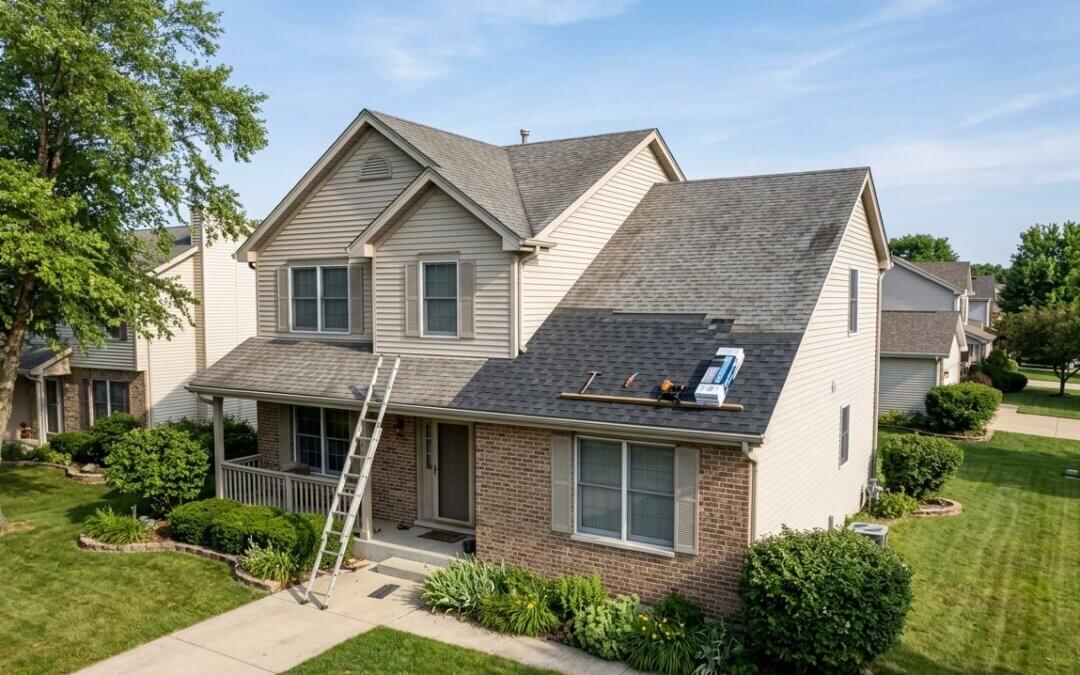
Last updated: July 5, 2026
Run an experiment with any fifteen-year-old roof in the Fox Valley: put one ceiling stain in front of three roofing companies and collect the verdicts. The company built around selling new roofs will find a reason to replace it. The handyman will patch the spot above the stain and call it solved. The commissioned door-knocker will declare the whole thing storm-totaled and promise your insurance will pay. One roof, three answers — and each answer happens to be the one that pays the person giving it. The honest version starts with an actual repair-versus-replacement evaluation, not a sales script.
What follows is the decision framework as it should actually be run — roof age, extent of damage, deck condition, and what the repair history already tells you — from a family-owned contractor that has been making this exact call for Fox Valley homeowners since 1999. None of it requires taking anyone’s word for anything.
Table of Contents
- Why one roof gets three different answers
- When a repair is the right call
- When repair is throwing money at a dying roof
- The repair-history math
- The matching-shingle problem
- What a real inspection covers
- Six questions that expose the honest answer
- FAQ
Why one roof gets three different answers
Because roofing advice is rarely disinterested. A replacement can pay a commissioned salesman many times what a repair does. A repair is the only thing a handyman is equipped to sell. And a storm chaser eats only if a claim gets filed. None of those incentives knows a single thing about your roof.
You can’t remove the incentives, but you can neutralize them: make every bidder argue their recommendation against the same physical evidence — the age of the shingles, the spread of the damage, the condition of the deck underneath. A contractor who can’t walk you through that case, photo by photo, is selling a quota, not a diagnosis. Our guide to finding reliable roofers near you covers the vetting side of this, and the FTC’s home-improvement scam guidance covers the people who fail it.
When a repair is the right call
Repair wins when the roof is young enough to have real life left and the damage is contained enough to isolate: a run of wind-lifted shingles, a cracked pipe boot, failed flashing at a chimney or sidewall, a few nail pops telegraphing through the surface. Fix the failure point, keep the roof.
Most leaks aren’t shingle failures at all — they’re penetration and flashing failures, which is why a targeted fix so often ends the problem for good. On a roof somewhere in its first twelve to fifteen years with a sound deck under it, a proper repair isn’t a band-aid; it’s maintenance, the same as fixing one bad window instead of residing the house. Look down any list of common roofing problems and it’s dominated by exactly these small, isolatable failure points — not by roofs that suddenly died everywhere at once.
When repair is throwing money at a dying roof
Repair becomes waste the moment a roof stops failing in spots and starts failing as a system. Widespread granule loss, shingles curling or cracking across the sun-hammered slopes, leaks that keep surfacing in new places, a deck that feels soft underfoot — at that stage, every repair is a toll payment on a road that’s closing.
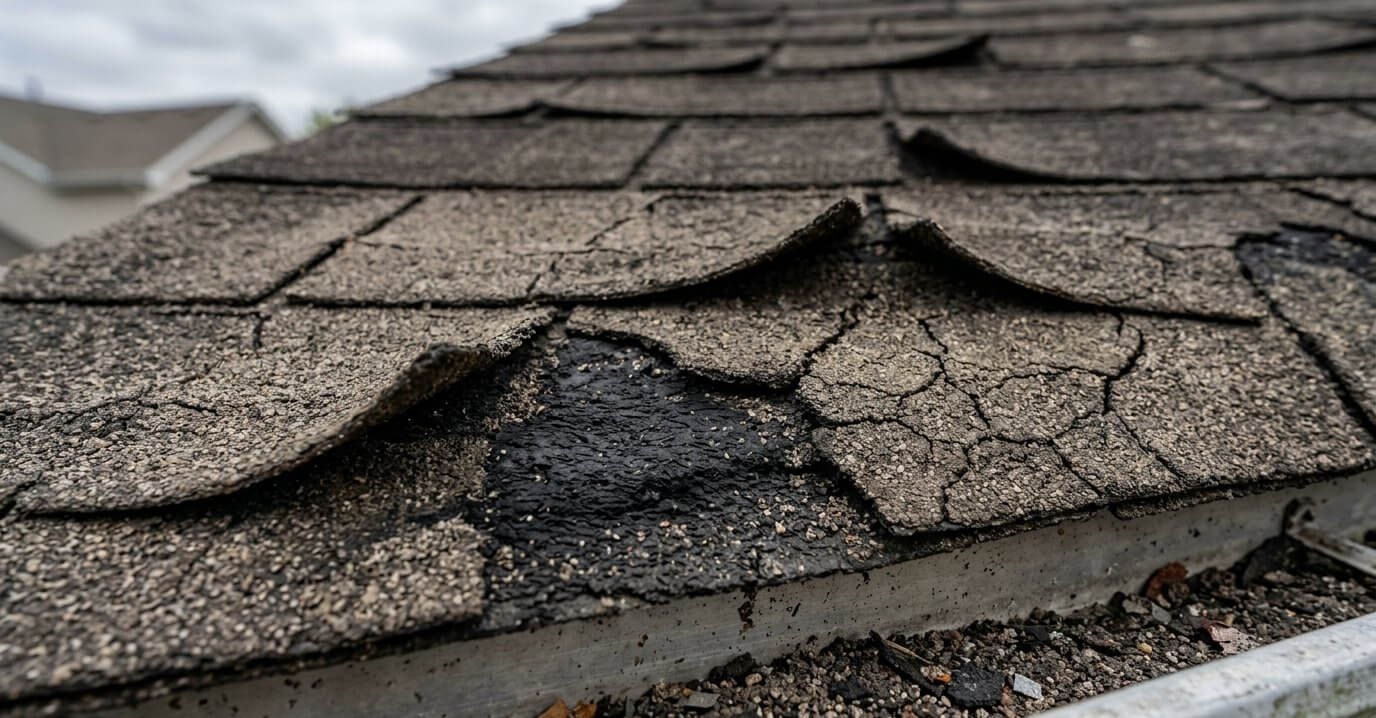
The tell is the pattern, not any single symptom. A stray leak on a nine-year-old roof is an event; the third leak in two winters on a nineteen-year-old roof is a trend line. And Illinois weather bends that line down harder than the shingle wrapper suggests — our breakdown of how long a roof really lasts in Illinois gets into exactly why. Paying retail, repair after repair, to chase leaks across a roof that is aging out on schedule isn’t frugal. It’s the most expensive way there is to buy time.
The repair-history math
The industry keeps a rough rule of thumb: once a repair bill climbs toward a meaningful fraction of replacement cost — some contractors draw the line near a quarter — replacement usually wins, because you’re spending serious money to extend a roof that keeps aging anyway. Treat the exact ratio as directional, not gospel.
The more useful math is the one homeowners rarely do: add up what the roof has cost across the last three or four years. Two or three separate service calls on an aging roof means you’re already paying for a replacement — in installments, with nothing permanent to show for it. When the honest answer turns out to be a new roof, spreading the cost deliberately through roofing financing beats spreading it accidentally through repeat repairs. Same money, and one of the two paths ends with a roof under warranty.
The matching-shingle problem
Even a technically perfect repair carries a cosmetic catch: shingles fade for years under UV, and manufacturers retire colors and product lines. A patch cut from fresh bundles almost never disappears into a fifteen-year-old field of weathered shingles. On a rear slope, nobody cares. On the front elevation, everybody does.
This is worth settling before work starts, not after. A good contractor will tell you plainly whether your shingle is still manufactured — current CertainTeed lines, which we install, can usually be matched closely; a discontinued line from 2009 cannot — and exactly where the mismatch will sit. Matching also becomes a genuine point of negotiation on partial storm damage, where “repairable” and “reasonably uniform in appearance” can be two different claims conversations. That route has its own playbook: see how storm damage insurance claims actually work in Illinois.
What a real inspection covers
A real inspection reads the whole system: the shingles, the flashing at every wall and penetration, the roof edge, the deck — and the attic side, where staining, daylight, and rusted nail tips confess problems the surface hides. Twenty minutes of walking shingles is an estimate. This is an inspection.
The attic matters more than most homeowners expect, because airflow quietly sets a roof’s aging speed — enough that we wrote a separate piece on how attic ventilation decides how shingles age. Inspections and estimates are free at AAA Roofing, and the findings come back as photographs you can hold every other bidder’s recommendation against. That’s the entire point of the exercise: converting three conflicting sales pitches into one set of facts. Our process page shows what that looks like from first call to final walkthrough.
Six questions that expose the honest answer
Whatever a bidder recommends, these questions separate an evidence-based call from a commission-based one:
- “Why is that the right call for a roof of this age?” The answer should reference your roof’s actual installation year, not a generality about roofs.
- “What condition is the deck in — and how do you know?” If nobody looked in the attic, nobody knows.
- “If you’re recommending repair, how many years is it buying me?” You want an honest range with reasoning, not a shrug.
- “If you’re recommending replacement, what specifically makes repair a bad investment here?” “It’s old” is a start, not an argument. Photos or it didn’t happen.
- “What’s your Illinois roofing license number?” Verify it through the IDFPR before anyone touches your roof — ours is #104.015004.
- “Will the repair shingles match, and where will any mismatch be visible?” This gets answered before the ladder goes up, not after.
More of the questions we hear every week — with straight answers — live on our roofing FAQ page.
FAQ
Is it cheaper to repair or replace a roof?
A repair is almost always cheaper today; the real question is cost per year of roof life bought. Early in a roof’s life, repairs buy years cheaply. Late in its life, the same money buys months. That’s why age and repair history — not the size of any single bill — should drive the decision.
Can you replace just one slope of a roof?
Yes — slope-by-slope replacement is a real option, most often when storm damage is confined to a single exposure. It makes sense on a roof with genuine life left in the other slopes. On an aging roof it usually doesn’t: you pay for setup twice and end up with slopes failing on two different schedules for the rest of the roof’s life.
How many times should a roof be repaired before replacing it?
There’s no magic count — the pattern matters more than the number. One repair every few years on a mid-life roof is normal maintenance. Multiple repairs in consecutive seasons, each in a new location, is a roof announcing system-wide failure. When leaks stop repeating in one place and start migrating, repairs have shifted from fixing the roof to subsidizing it.
Will a roof repair match my existing shingles?
Close, usually; invisible, rarely. Your existing shingles have faded for years, and the original color or product line may be discontinued, so even a well-matched patch can read slightly different in raking light. A good contractor confirms whether your shingle is still manufactured and tells you exactly where any mismatch will sit — before starting the work.
Want the call made on evidence, not commission?
If your roof is at the ambiguous age where every bidder tells a different story, get the version backed by photographs. Request a free inspection from AAA Roofing and we’ll show you what the roof actually says — repair, replacement, or leave it alone — and let the evidence make the argument.
About the publisher
AAA Roofing Company is a family-owned, Illinois-licensed roofing contractor in Sugar Grove serving the Fox Valley and Chicagoland’s western suburbs since 1999. Learn more about the company or explore our residential roofing services.