
Last updated: July 5, 2026
The wrapper on a bundle of shingles promises decades — thirty years, forty, “limited lifetime.” Those numbers are real in the way a treadmill stress test is real: earned under controlled conditions your roof will never see. An Illinois roof lives outdoors in one of the more abusive shingle climates in the country — dozens of freeze-thaw swings every winter, a genuine hail season, attics that bake through July — and it ages on that schedule, not the laboratory’s. Which is why the honest starting point for any residential roofing conversation is the real number, not the printed one.
After roofing the Fox Valley since 1999, we’ll tell you the real number is decided by four things — material, climate, installation quality, and ventilation — and that brand runs a distant fifth. Here’s how to think about each one, what the common materials actually deliver in this climate, and how to read where your own roof sits on the curve — before a leak reads it for you.
Table of Contents
- What the number on the wrapper actually means
- Real-world lifespan ranges by material
- What Illinois takes off the number
- Aging versus damage: reading what you see
- Why installation and ventilation beat brand
- Five questions that date any roof
- FAQ
What the number on the wrapper actually means
The number on the wrapper is a warranty term, not a service-life prediction. A “30-year” shingle is a shingle whose manufacturer will prorate certain manufacturing defects across thirty years — with coverage that typically shrinks sharply after an initial window. It’s a legal document about factory defects, not a promise about weather.
“Limited lifetime” is the same idea with better marketing: coverage that runs as long as the original owner keeps the home, prorated and conditioned along the way. Read the exclusions and a pattern emerges — warranties don’t cover hail, wind beyond the rated speed, an overheated attic, or bad nailing, which between them account for most early roof deaths in this state. Even the industry’s own trade group, the Asphalt Roofing Manufacturers Association, devotes most of its homeowner guidance to everything around the shingle — ventilation, installation, maintenance — which tells you where the industry itself thinks the real risk lives.
Real-world lifespan ranges by material
The commonly cited industry ranges, treated as ballparks: three-tab asphalt, roughly 15–20 years; architectural asphalt, roughly 22–30; metal, 40–70; cedar, 20–30 with diligent upkeep. Illinois tends to collect from the low end of each range. Treat these as orientation, not promises.
The spread inside each range is the real story — two architectural roofs installed the same summer can hit failure a decade apart. Architectural shingles, including the CertainTeed lines we install, earn their premium over three-tab mostly in mass and wind rating, both of which matter here. Metal’s long life carries its own asterisks — fastener gaskets age, panels move, and large hail leaves cosmetic dents that insurers argue about — and cedar’s number assumes a maintenance discipline almost nobody sustains past the first decade. Material picks the neighborhood; everything else in this article picks the house. When replacement time comes, that conversation belongs inside a new-roof estimate built on your actual house, not inside a brochure.
What Illinois takes off the number
Freeze-thaw is the quiet tax. Water works into microscopic gaps in shingles and flashing, freezes, expands about nine percent, and pries every gap a little wider — dozens of cycles each winter, every winter. Add spring hail, summer attic heat, and straight-line winds, and Illinois trims years off any laboratory lifespan.
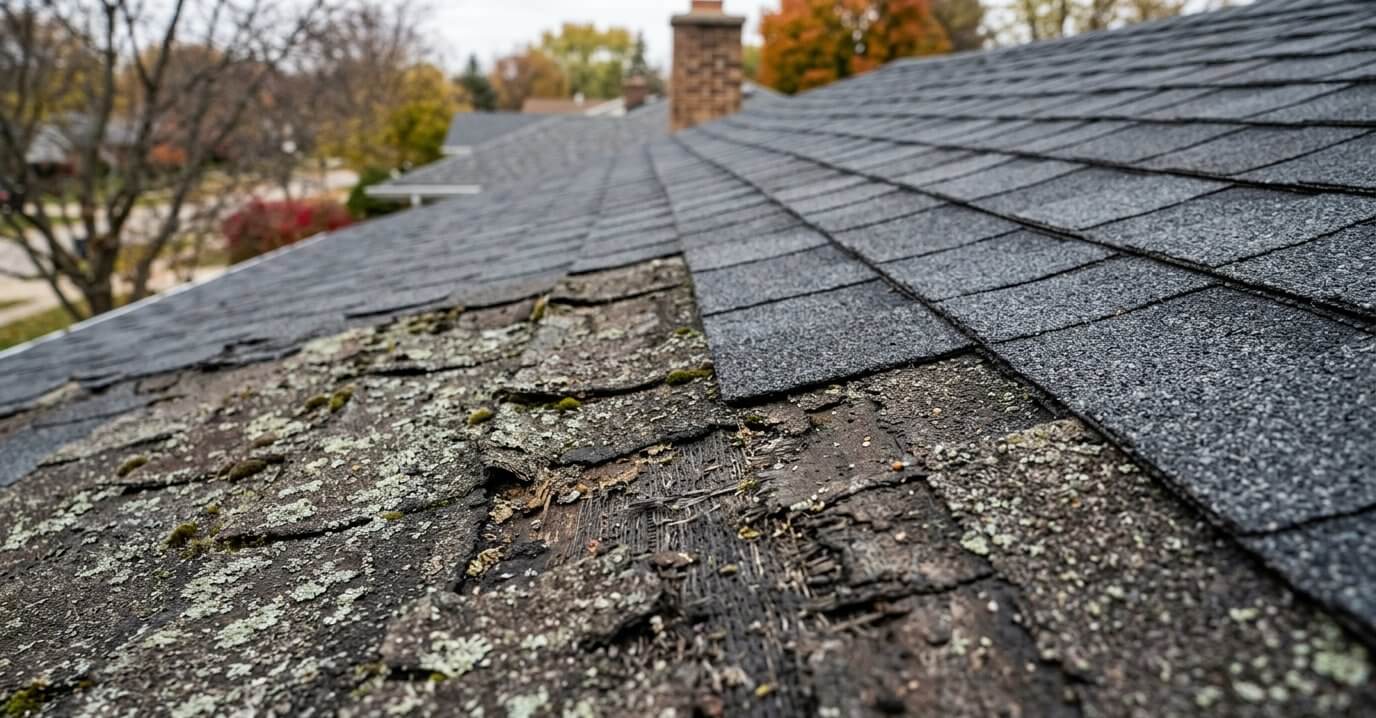
Each stress leaves its own signature. Freeze-thaw shows up as cracking, split flashing, and popped fasteners. Hail leaves bruises that shed granules years ahead of schedule. Heat — the one homeowners consistently underrate — curls and embrittles shingles from below; we’ve broken down what heat does to a roof separately because it deserves the space. What matters is that these stresses compound rather than merely accumulate: a hail-bruised shingle sheds its granule armor, UV then attacks the exposed asphalt, and the freeze-thaw cycle exploits the resulting cracks. An Illinois roof doesn’t age steadily. It ages faster every year it’s already aged. Wind rounds out the lineup — not just the headline gusts that peel tabs off in one afternoon, but the routine 40-mph fronts that fatigue the sealant bond a little more with each pass until some ordinary Tuesday finishes the job.
Aging versus damage: reading what you see
Aging is uniform and slow: granules thinning across whole slopes, edges curling on the sun-hammered southern exposure, bald patches, brittleness. Damage is local and datable: bruises, creases, missing tabs that appeared after a specific storm. The distinction matters because one is a maintenance conversation and the other may be an insurance claim.
Getting it wrong costs money in both directions. Write off storm damage as “just an old roof” and you forfeit a legitimate claim; file age as storm damage and you put a going-nowhere claim on your record. A trained eye can tell a hail bruise — dark, soft underfoot, granules displaced — from a heat blister or plain wear, and the difference decides everything downstream. If a storm is anywhere in the picture, the claims route has its own rules worth knowing first: how storm damage insurance claims actually work in Illinois. And check the perimeter before the field — the edge usually confesses first, which is why the roof edge is the first place your roof fails.
Why installation and ventilation beat brand
Installation quality and attic ventilation move a roof’s lifespan more than any brand decision on the market. High nails, overdriven nails, wrong nailing patterns, skipped starter courses, improvised flashing — these kill roofs in their first decade. A starved attic quietly cooks the same roof from below for every summer it stands.
This is the least brochure-friendly truth in roofing: a careful install of a mid-tier shingle will outlive a sloppy install of a premium one, reliably. Ventilation is a big enough subject that we gave it its own article on how attic ventilation decides how shingles age, but the short version is that heat and moisture with no exit attack the shingles and the deck from underneath, invisibly. The attic side of the equation — air sealing and insulation working with ventilation — is laid out well in ENERGY STAR’s seal-and-insulate guidance. All of it is why the process a contractor follows predicts your roof’s lifespan better than the logo on the bundle.
Five questions that date any roof
Whether it’s your roof or one attached to a house you’re about to buy, these five questions place it on the curve faster than any wrapper ever will. None of them requires a ladder — just paperwork, an attic hatch, and honest answers:
- When was it installed — and is there paper? Permits, closing documents, or the installer’s records beat anyone’s memory.
- One layer or two? An overlay roof ages faster, hides the deck, and complicates the eventual replacement.
- What does the attic side look like? Rusted nail tips, water staining, and daylight through the deck out-testify anything visible from the driveway.
- What’s the repair history? Leaks that migrate to new spots each season signal system failure; one well-made fix years ago signals nothing. Roof installed by AAA? Workmanship problems in its first three years are covered by our warranty service.
- Is the ventilation actually working? Blocked soffits and mismatched vents shorten every estimate you’ll make from the other four answers.
For the symptoms worth watching between inspections, our rundown of common roofing problems and the winter roof inspection checklist cover the field.
FAQ
How often do roofs need to be replaced in Illinois?
For the asphalt shingle roofs that cover most Illinois homes, plan around two to three decades depending on the shingle grade, the installation, and the attic under it — with hail holding the wild card. The more useful habit than counting years is inspecting: a roof past its mid-teens has earned a professional look every couple of years.
Can a roof last 30 years in Illinois?
Yes — but it’s earned, not printed. A thirty-year Illinois roof is almost always an architectural shingle over a properly ventilated attic, nailed correctly, flashed correctly, and lucky enough to dodge a direct hail hit. Miss the ventilation or the installation quality and the same shingle can be done in half that time. The wrapper never had a vote.
How can I tell how old my roof is?
Start with paper: building permits, your closing documents, or the previous owner’s records. No paper? Read the roof — uniform granule loss, curling edges, and brittle tabs suggest a roof deep into its life, while the attic side adds testimony through nail rust and staining. A professional inspection can usually bracket the age within a few years.
Is a metal roof worth it in Illinois?
Sometimes. Metal’s commonly cited 40–70 year range is real, it sheds snow well, and it shrugs off freeze-thaw better than asphalt. The trade-offs are a higher upfront cost, cosmetic vulnerability to large hail, and detail work — fasteners, panel movement — that punishes inexperienced installers. For many homeowners, a quality architectural shingle hits the better cost-per-year.
Want the real number for your roof?
Every roof in the Fox Valley is somewhere on this curve; the only question is where yours sits. Book a free roof inspection with AAA Roofing and get the evidence-backed version — what’s aging, what’s damaged, and how many honest years are left — instead of a guess read off a wrapper.
About the publisher
AAA Roofing Company is a family-owned, Illinois-licensed roofing contractor in Sugar Grove serving the Fox Valley and Chicagoland’s western suburbs since 1999. Learn more about the company or explore our residential roofing services.