
Last updated: July 5, 2026
Nobody photographs their gutters. The shingles get the drone shots, the front elevation gets the listing photos, and the aluminum trough doing the actual water management gets cleaned twice a year at best and looked at never. But walk any Fox Valley street after fifteen years of weather and you’ll notice the roofs aren’t failing in the middle of a slope — they’re failing at the edge: overflowing gutters, streaked fascia, soffit going soft, ice hanging where ice shouldn’t be. Water is patient, and it always attacks the seams. The roof edge is the seam.
The edge is a four-part assembly running a relay — shingles to drip edge to gutter to downspout — and a fumble anywhere in the chain sends water somewhere expensive: behind the fascia, into the soffit, down the siding, into the basement. Here’s how the assembly works, how it fails, and when the boring answer — replace the gutters with the roof — is the right one. From a contractor that has been rebuilding Fox Valley roof edges since 1999.
Table of Contents
- The edge assembly: four parts, one job
- The overflow damage chain
- Ice dams: why the eave is ground zero
- Fascia and soffit: the wood that tells the truth
- Should gutters be replaced with the roof?
- The seasonal maintenance reality
- FAQ
The edge assembly: four parts, one job
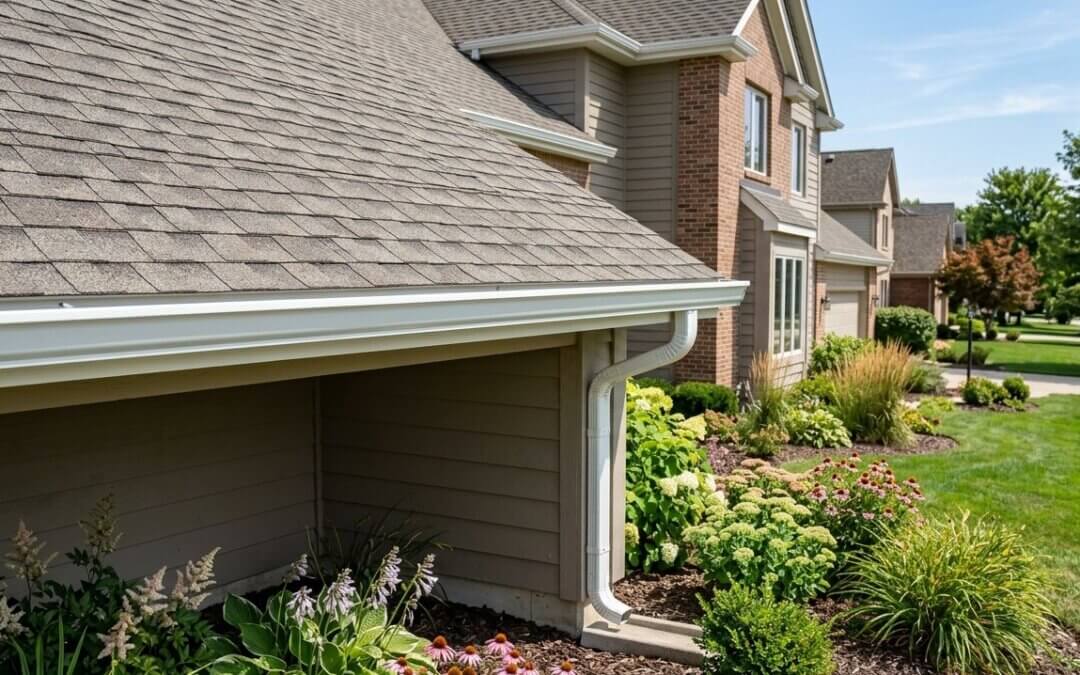
Four parts, one job. The drip edge is the metal lip that throws water clear of the wood. The fascia is the vertical board that carries the gutter. The gutter catches the runoff of the entire roof, and the downspout moves it away from the foundation. Each part exists to protect the one behind it.
What homeowners underestimate is the scale of the work: an ordinary roof sheds hundreds of gallons in a single hard rain, and all of it gets funneled into a channel a few inches wide. The drip edge earns special respect here — without it, surface tension pulls water backward around the shingle edge and down the face of the fascia, an invisible, permanent drip line that rots wood behind fresh paint. The parts are designed to overlap so water can never reach wood, which is why the edge gets built as one system on any residential roof worth the name — not accumulated piecemeal across three decades of separate projects.
The overflow damage chain
A clogged gutter doesn’t just spill forward over the lip. It backs water up over its rear edge, against the fascia and under the first course of shingles. From there the chain is predictable: fascia paint peels, the wood rots, the soffit follows, the siding streaks, and the overflow trenching along the foundation finds the basement.
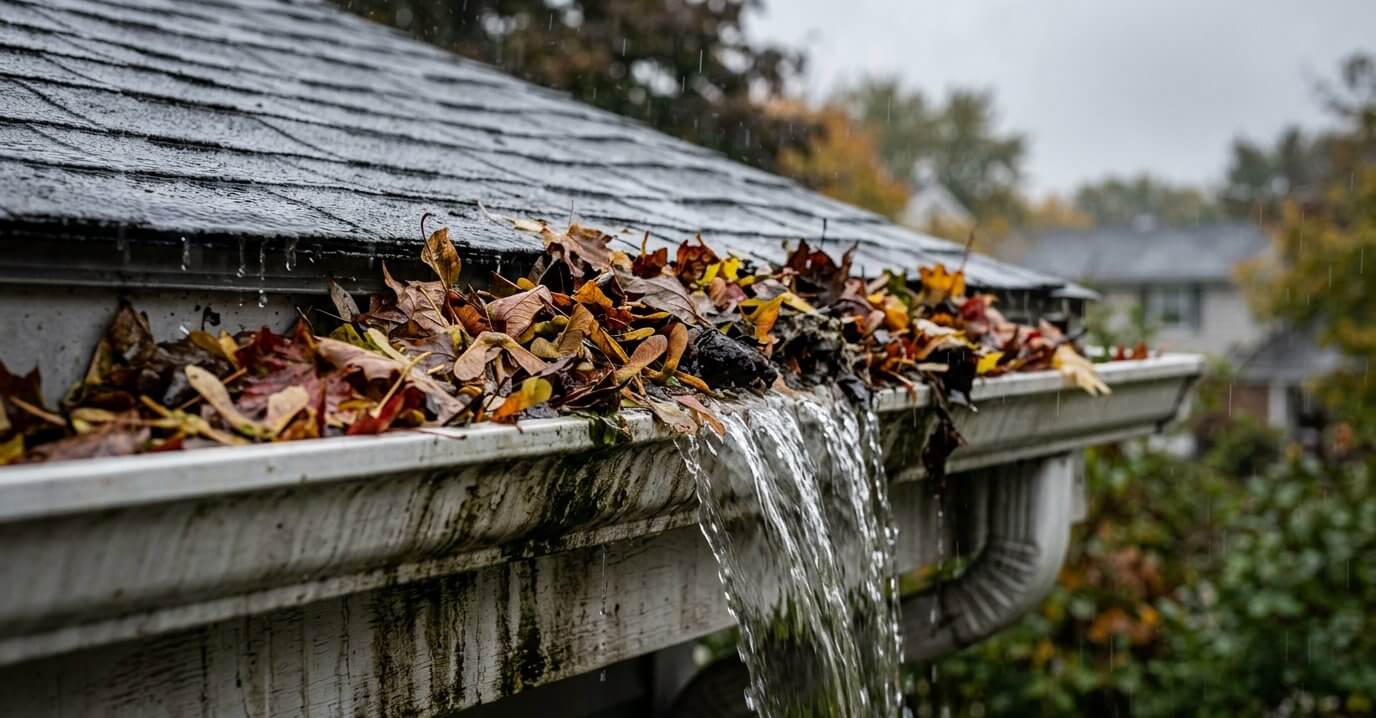
The chain runs mostly out of sight, in order, for seasons before anything looks wrong — by the time fascia is visibly soft, the water has been winning for years. The exterior tells are readable from the lawn: tiger-striping down the gutter face, splash-trenched mulch under the eave, staining at the top of the siding panels. None of it is cosmetic; all of it is the same water taking the same detour. The edge is also where storms testify first — dented gutters and creased edge metal are corroborating evidence when a storm damage insurance claim is on the table, which is one more reason not to replace bent metal before it’s been photographed.
Ice dams: why the eave is ground zero
An ice dam is a heat leak you can see from the street. Warmth escaping into the attic melts the snowpack from below; meltwater runs down the roof until it crosses the overhang — the only stretch of roof with no heated house beneath it — and refreezes into a growing ridge of ice that backs water uphill, under the shingles.
The eave is ground zero because it’s the temperature boundary, and the gutter makes an ideal anchor: a trough full of ice gives the dam something to build on, then transfers that load to hangers and fascia that were never sized for a hundred pounds of ice. The durable fix isn’t chipping — it’s controlling attic heat, a ventilation-and-insulation problem: why attic ventilation decides how your shingles age covers the mechanism, and ENERGY STAR’s seal-and-insulate guidance covers the other half. Ice-and-water membrane at the eave is standard practice here for a reason, but it’s the backstop for what still gets through — not the cure. Our winter roof inspection checklist treats icicle patterns as diagnostic data, because that’s what they are.
Fascia and soffit: the wood that tells the truth
Fascia and soffit are the honest witnesses of the roof edge. They’re the first wood the water reaches, so they confess problems while the shingles above still look respectable: peeling paint, dark streaks, seams opening up, wood that gives under a thumb. That’s the edge reporting a failure somewhere upstream.
Which is the part that gets misdiagnosed: rotted fascia is never just a fascia problem. It means water has been arriving where it shouldn’t for a long time — a chronic clog, a pitch problem, missing drip edge, or a recurring ice dam — and replacing the board without finding the source is repainting a symptom. Soft fascia also can’t grip gutter hangers, so the gutter sags, holds standing water, and accelerates its own failure. It’s one of the most commonly misread items in the whole catalog of common roofing problems, and a competent roof repair at the edge starts by tracing the water path, not by quoting the lumber.
Should gutters be replaced with the roof?
If the gutters are anywhere near the roof’s age, replace them together. The drip edge and gutter are meant to overlap so water can’t slip behind either one, and that handoff gets built correctly when both go in as one system. A brand-new roof draining through twenty-year-old gutters is a new engine bolted to a rusted exhaust.
The practical arguments stack up fast. Hangers rarely survive removal and re-hanging at full strength. Pitch gets reset correctly when gutters go up fresh, instead of preserving two decades of accumulated sag. The flashing sequence gets layered as one era of construction rather than caulked together across two. And the roof’s own schedule matters — if the shingles are done, the gutters that aged beside them are rarely far behind, a calculus covered in how long a roof really lasts in Illinois. When you’re pricing a roof replacement, make the estimate address the gutters explicitly either way: “keeping the existing gutters” should be a decision with reasoning attached, not a silence.
The seasonal maintenance reality
The realistic schedule: the roof edge needs attention twice a year — once after the leaves finish falling, once after winter lets go — plus a glance during the first hard rain of each season. Every check below works from the ground, no ladder required. What you’re really doing is watching how water behaves.
- Watch the gutters in a hard rain. Overflow mid-run means a clog or a pitch failure; overflow everywhere means undersized or dead gutters.
- Look for tiger-striping on the gutter faces. Those vertical streaks are the residue of routine overflow, months of it, written in dirt.
- Sight down the fascia line. A straight board is carrying its load; waves and sag are the hangers or the wood behind them giving notice.
- Follow every downspout to the ground. Water should leave the foundation, not recycle into it three inches from the wall.
- In winter, map the icicles. A few small ones after freezing rain is weather. Thick ice at the same stretch of eave every cold week is heat escaping — a symptom, not a decoration.
The Fox Valley makes this discipline non-optional: the spring convective season and the winter freeze-thaw whiplash that NWS Chicago forecasts for our counties test the edge far harder than they test the field of the roof.
FAQ
Can clogged gutters damage a roof?
Yes — and the damage lands above and below the gutter, not in it. Backed-up water pushes under the first shingle course and against the fascia, rotting the edge of the roof deck, while the overflow trenches along the foundation. The gutter itself usually survives; the wood behind it and the basement below it pay the bill.
Should gutters be replaced before or after a new roof?
Ideally with it, as one project — the drip edge and gutter get integrated correctly and the edge goes together as a single system. If they must be separate projects, roof first, then gutters: hanging new gutters under a roof that’s about to be torn off is paying to have them dented and re-hung.
How do I know if my fascia board is rotted?
Look for peeling or bubbling paint, dark vertical streaks, open seams at the corners, and a gutter line that waves or sags. Confirmation is tactile: sound wood resists a firm press, rotted wood gives. Any softness means the water source upstream — clog, pitch, drip edge, ice dam — needs diagnosing before the board gets swapped.
Do gutter guards stop ice dams?
No. Ice dams are a heat problem — attic warmth melting snow that refreezes at the cold eave — and guards only manage debris. A guarded gutter fills with ice exactly as fast as an open one. Guards earn their keep against leaf clogs and overflow; ventilation, air sealing, and insulation are what fight the dam.
Get the edge looked at before water makes the decision
The edge fails quietly, then all at once — and every stage of the chain is cheaper to fix than the one after it. Schedule a free inspection with AAA Roofing and the whole assembly gets read together — shingle edge, drip edge, fascia, gutters, downspouts — with photos of whatever the water has been doing while nobody looked.
About the publisher
AAA Roofing Company is a family-owned, Illinois-licensed roofing contractor in Sugar Grove serving the Fox Valley and Chicagoland’s western suburbs since 1999. Learn more about the company or explore our residential roofing services.