Last updated: July 28, 2026
A low-slope commercial roof reaches a decision point long before it fails. Somewhere around year fifteen the seams start opening, the ponding areas hold water a day longer than they used to, and the maintenance line item stops being a rounding error. At that point a building owner gets two very different proposals: coat it, or tear it off. They differ by an order of magnitude in cost and disruption, and the honest answer is that only one of them is available to any given building. The deciding factor is what is underneath, which is why the inspection matters more than the sales pitch. This is how roof coatings and full commercial replacement actually compare, and how to tell which one your roof qualifies for.
Table of Contents
- What a roof coating is, and what it is not
- The one question that decides it: is the substrate dry?
- Silicone vs acrylic vs urethane
- Coating vs tear-off, side by side
- Where coatings fail, and why
- If it is a tear-off: TPO, EPDM, and the flat-roof alphabet
- The multifamily and property-manager case
- Frequently asked questions
What a roof coating is, and what it is not
A roof coating is a fluid-applied membrane rolled or sprayed over an existing roof, curing into a seamless monolithic surface bonded to what was already there. It is a restoration of a functioning roof, not a substitute for a failed one. That distinction carries the entire decision.
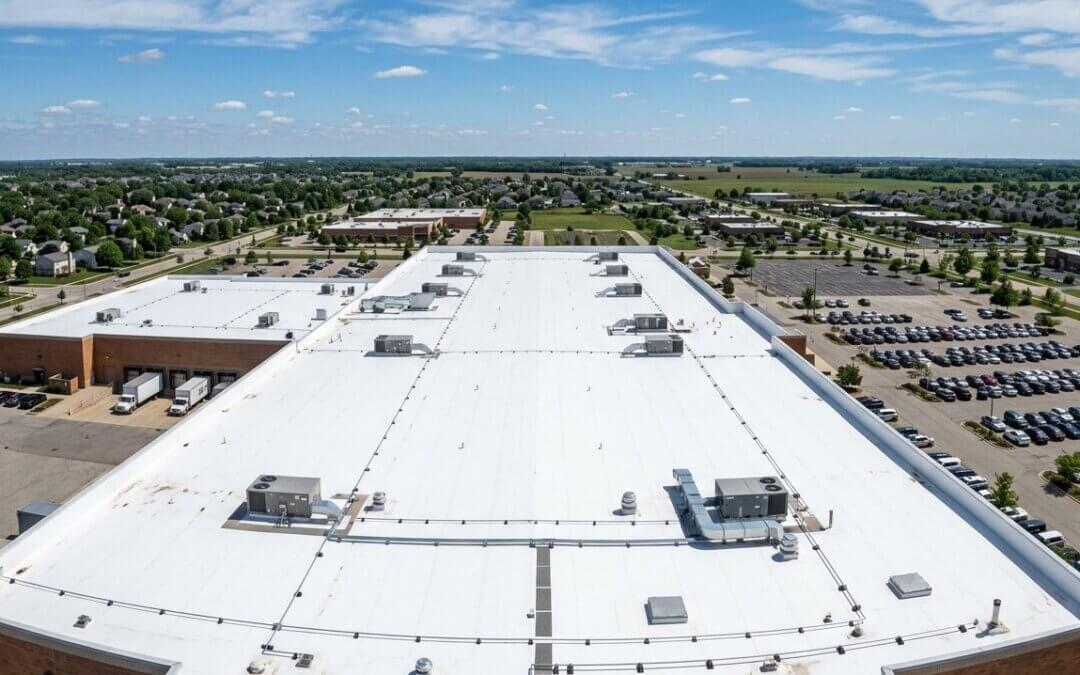
Applied to a sound substrate, a coating does several things at once. It seals seams, laps, and fastener penetrations across the whole field rather than patch by patch. It restores reflectivity, which on a dark aged membrane in an Illinois summer meaningfully lowers rooftop surface temperature and the cooling load underneath it. It renews UV protection on a membrane that has been losing it since installation. And it does all of that without a tear-off, which means no dumpsters, no exposed deck, and in most cases no interruption to whatever is happening inside the building.
What it does not do is fix wet insulation, structural deck problems, or a membrane that has lost adhesion. A coating conforms to the roof it is applied to. Coat a roof with saturated insulation and you have sealed the moisture in, where it will continue degrading the deck out of sight while the surface looks new. That failure mode is the reason coatings have a mixed reputation, and it is entirely a diagnosis problem rather than a product problem.
The one question that decides it: is the substrate dry?
A commercial roof qualifies for a coating when the membrane is intact and adhered, the insulation below it is dry, and the deck is structurally sound. If any of those three is false, the roof needs replacement and no coating will change that.
Finding out is a survey, not an opinion. A proper assessment on a low-slope roof involves core cuts, physically removing small plugs through the assembly at representative locations to see the insulation and deck condition directly, plus a moisture scan across the field. Infrared surveys read the roof at dusk, when wet insulation releases stored heat more slowly than dry insulation and shows up as a thermal signature. Capacitance and nuclear meters give a complementary read. The point of doing more than one is that each has failure modes, and agreement between methods is what makes the map trustworthy.
The useful outcome is a percentage. A roof with isolated wet areas totaling a small share of the field can often have those sections cut out and replaced, then be coated as a system. Once saturation passes roughly a quarter of the roof area, the arithmetic turns and replacement becomes the cheaper answer, because at that point you are paying to remove and rebuild most of the assembly anyway while also buying coating for the rest.
Any proposal to coat a roof that arrives without core cuts or a moisture scan is a guess. That is worth saying plainly, because the cost of the survey is trivial against the cost of coating a wet roof and discovering it three years later.
Silicone vs acrylic vs urethane
Three chemistries dominate the commercial coating market, and they are not interchangeable. The Illinois climate, with its freeze-thaw cycling and its genuinely hot humid summers, narrows the field more than a national spec sheet suggests.
| Silicone | Acrylic | Polyurethane | |
|---|---|---|---|
| Ponding water | Excellent, does not re-emulsify | Poor, softens under standing water | Good |
| UV stability | Excellent | Good | Fair, usually needs a topcoat |
| Impact and foot traffic | Fair, softer surface | Fair | Excellent, best abrasion resistance |
| Dirt pickup | Holds dirt, reflectivity drops over time | Stays cleaner | Moderate |
| Recoating later | Only silicone bonds to silicone | Straightforward | Straightforward |
| Best fit | Roofs that pond, low-traffic fields | Sloped-to-drain roofs, reflectivity priority | Traffic areas, mechanical zones |
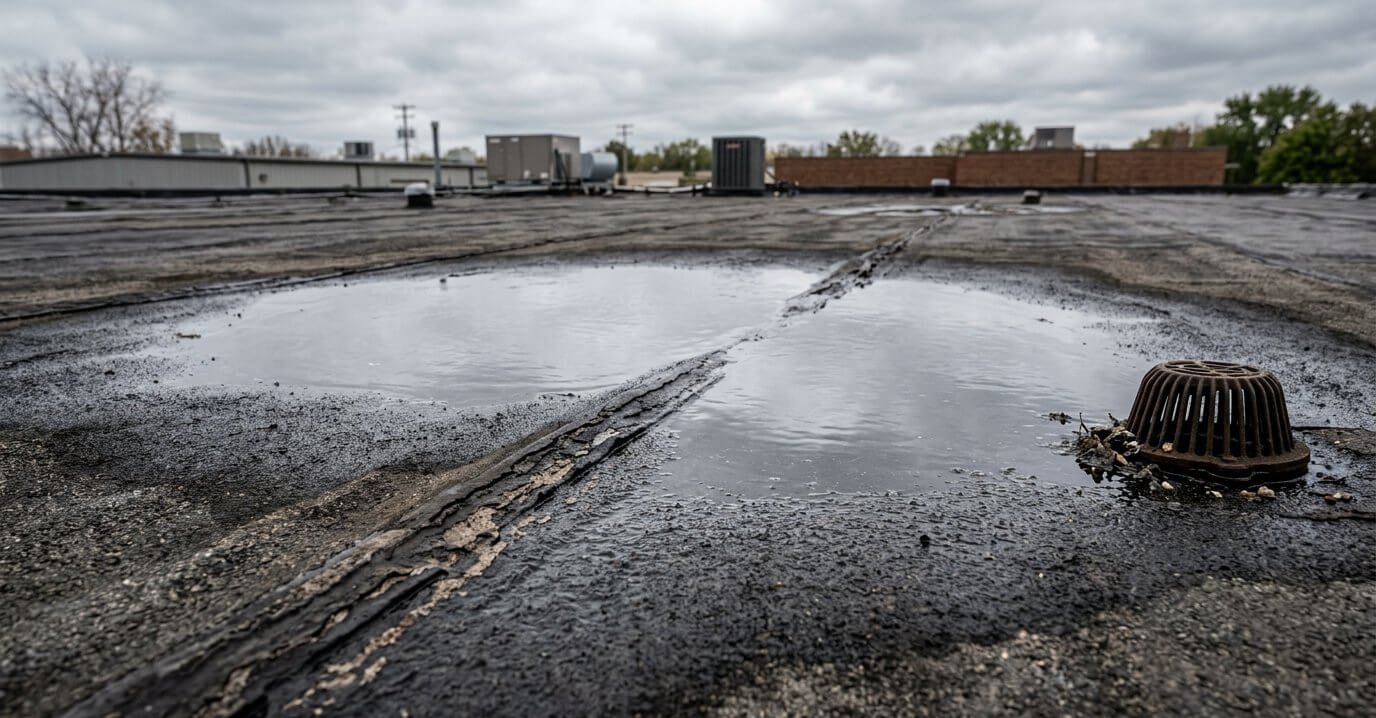
For most Fox Valley low-slope roofs the ponding row decides it. Flat roofs in this region rarely drain as designed after two decades of deck deflection and drain settlement, and any roof that holds water for more than a couple of days after rain is a poor candidate for acrylic. Silicone tolerates standing water indefinitely, which is why it dominates restoration work on aged built-up and modified bitumen roofs.
Silicone’s tradeoffs are real and worth knowing before you choose it. It attracts and holds dirt, so the bright initial reflectivity settles into something duller within a couple of seasons, which matters if the energy case is the main reason for the project. It is slick when wet, which is a genuine safety consideration on a roof with regular mechanical service. And it commits you: once a roof is siliconized, the only thing that will bond to it later is more silicone. That is not a defect, but it is a decision about the roof’s next twenty years, so it belongs in the conversation rather than the fine print.
If reflectivity is the driver, the Cool Roof Rating Council publishes independently measured solar reflectance and thermal emittance values for rated products, including aged values rather than just initial ones. Aged numbers are the honest comparison, and ENERGY STAR maintains certification criteria for reflective roof products.
Coating vs tear-off, side by side
| Factor | Restoration coating | Full tear-off and replacement |
|---|---|---|
| Requires | Dry insulation, adhered membrane, sound deck | Nothing; it is the answer when the above fails |
| Business disruption | Minimal, work stays above the deck | Significant, deck exposed in phases |
| Tear-off waste | None, existing assembly stays | Full assembly to landfill |
| Fixes wet insulation | No | Yes |
| Fixes drainage design | No, unless tapered insulation is added | Yes, tapered system can be designed in |
| Renewable later | Yes, recoat extends again | Starts a new service life |
| Weather window | Narrow, needs dry surface and temperature range | Wider, phased with dry-in each day |
The pattern worth noticing is that a coating buys time on a roof that is still fundamentally working, and it buys that time cheaply and without shutting a business down. A tear-off resets the clock and fixes problems a coating cannot reach. Neither is the better product in the abstract. The roof decides.
One scheduling note specific to northern Illinois: coatings need a dry substrate and surface temperatures within the manufacturer’s range, which in practice compresses the application window to roughly late spring through early fall. A coating project identified in November is usually a spring project, and planning it that way beats rushing an application into marginal conditions.
Where coatings fail, and why
Coating failures cluster into a small number of causes, and none of them are mysterious.
- Applied over wet insulation. The most common and the most expensive. The moisture stays, the deck keeps degrading, and the failure surfaces years later as deck rot rather than as a coating problem.
- Inadequate surface preparation. A coating bonds to what it touches. Applied over a dirty, chalked, or oil-contaminated surface, it bonds to the contamination and peels with it. Power washing and, on many substrates, a primer are part of the system rather than optional extras.
- Under-applied film thickness. Coating performance is a function of mil thickness, and thickness is a function of gallons per square. This is the quiet way a bid gets cheaper. Ask for the specified dry film thickness and the gallons the job is priced at, then ask how thickness will be verified during application.
- Details skipped. Seams, penetrations, drains, curbs, and parapet transitions usually need reinforcing fabric embedded in the coating. Rolling the field and calling it done leaves every hard part unaddressed, and the hard parts are where roofs leak.
- Wrong chemistry for the conditions. Acrylic on a ponding roof is the classic. It will look fine for a year.
Every item on that list is visible in a written specification before anyone starts. That is the practical defense.
If it is a tear-off: TPO, EPDM, and the flat-roof alphabet
When the survey says replacement, the next question is the membrane. The two that dominate low-slope commercial work in this region are TPO and EPDM, and they suit different buildings.
TPO is a reflective white thermoplastic with heat-welded seams. The welded seam is its structural advantage, because it fuses the sheets into a continuous membrane rather than relying on adhesive, and the white surface carries a real cooling benefit on a building with significant summer load. EPDM is a black synthetic rubber with exceptional flexibility and a long field record in freeze-thaw climates, which is precisely the Illinois condition. Its seams are adhesive or tape-based, which puts more weight on installation quality, and its dark surface absorbs heat, which is a liability in July and arguably an asset in January.
Building use tends to decide. A conditioned building with meaningful cooling load and rooftop equipment usually points to TPO. A building with heavy freeze-thaw exposure, complex geometry, or a lot of movement often points to EPDM. Either way the insulation package and the drainage design matter more to the roof’s life than the membrane brand, and a replacement is the only moment you get to fix drainage by adding tapered insulation. Skipping that on a roof that has ponded for twenty years rebuilds the same problem in new material.
The multifamily and property-manager case
For apartment ownership and property management, the coating decision has a variable that owner-occupied buildings do not carry: residents are home. A tear-off over occupied units means noise above bedrooms, staged parking closures, debris control around entrances, and a genuine safety perimeter for weeks. A restoration coating avoids nearly all of it, which is often worth more than the line-item difference.
The other multifamily-specific factor is phasing. A portfolio of buildings rarely reaches end of life simultaneously, and coating the ones that still qualify while replacing the ones that do not lets capital spread across budget years instead of landing in one. Our multifamily roofing and property manager services pages cover how we scope work across multiple buildings, and a survey that produces a condition ranking across a portfolio is usually the first deliverable worth buying.
Frequently asked questions
How long does a silicone roof coating last?
Manufacturers publish service life based on applied dry film thickness, and a properly specified silicone restoration on a sound substrate is a long-term system rather than a stopgap. The variables that actually determine it are substrate condition at application, achieved film thickness, and detail work at seams and penetrations. Ask for the specific manufacturer’s published performance data for the thickness your job is being priced at, since a thinner application is a different product life than a thicker one.
Can you coat a roof that has ponding water?
Silicone handles ponding water better than any other common coating chemistry and does not re-emulsify under standing water, which is why it dominates restoration on aged flat roofs. Acrylic performs poorly in ponding conditions. Ponding itself is still a symptom worth addressing, because standing water accelerates every failure mode underneath it, and a replacement with tapered insulation is the only way to actually correct the drainage.
How do I know if my flat roof needs replacement instead of a coating?
Core cuts and a moisture scan answer it. If the insulation is dry, the membrane is still adhered, and the deck is sound, the roof is a coating candidate. If moisture has saturated a significant share of the field, or the deck shows structural deterioration, replacement is both the correct and eventually the cheaper option. Any coating proposal made without core cuts or a moisture survey is an assumption rather than a diagnosis.
Is TPO or EPDM better for an Illinois commercial roof?
Both perform well here and the building decides. TPO’s heat-welded seams and reflective white surface suit conditioned buildings with summer cooling load and rooftop equipment. EPDM’s flexibility gives it a strong record in freeze-thaw climates and on complex roof geometry. The insulation package and drainage design affect service life more than the membrane choice, so those deserve at least as much attention in the specification.
Will a roof coating stop an active leak?
Not reliably, and treating it as a fix for a leak is how coatings get a bad name. An active leak means water is already in the assembly, and coating over it seals the moisture in. The correct sequence is to find and repair the leak source, verify the surrounding insulation is dry or replace the wet sections, then coat the roof as a system. Coating is a restoration of a working roof rather than a repair of a failing one.
Get the survey before you get the proposal
The right answer for your building is a finding, not a preference, and it comes out of core cuts and a moisture scan rather than a walk-around. AAA Roofing has been handling commercial and multifamily low-slope work across the Fox Valley since 1999. Request a commercial roof assessment and we will tell you what the roof actually qualifies for, including when the answer is that it has years left and needs nothing.
About the publisher
AAA Roofing Company is a family-owned roofing contractor serving the Fox Valley and the western suburbs of Chicago since 1999, rated 4.9 stars across more than 119 Google reviews with an A+ rating from the Better Business Bureau. AAA Roofing Company, Inc., Illinois Roofing Contractor License #104.015004. Commercial, multifamily, and residential. See commercial roofing, roof coatings, or recent projects.